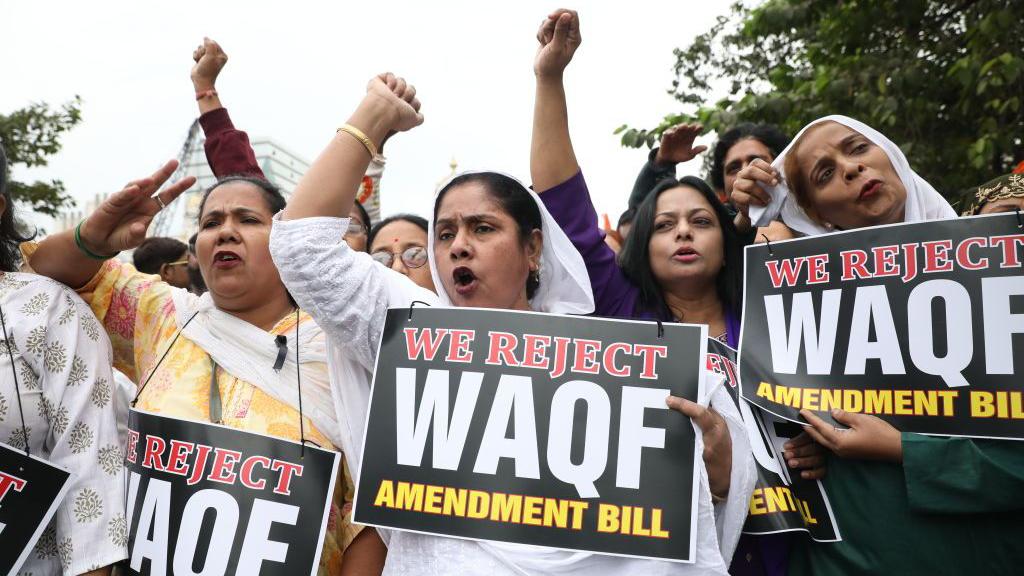
Chandigarh: The Waqf Amendment Bill has raised apprehensions among members of the Muslim community in Punjab, who fear that the ownership rights of Waqf properties, including graveyards situated on land owned by local bodies, could now be transferred to the government. The inclusion of non-Muslims in Waqf boards, even for administrative purposes, has also been strongly opposed.
Members of the community have argued that religious boards of other faiths, such as the Shiromani Gurdwara Parbandhak Committee (SGPC) and Hindu temple shrine boards, do not have representation from other religions. “If there cannot be representatives of other faiths in the SGPC or Hindu temple shrine boards, why does the government want to bring non-Muslims into Waqf boards?” asked a senior community leader, requesting anonymity.
Shahi Imam of Punjab, Maulana Mohammad Usman Ludhianvi, criticized the Bill, stating that instead of amending the Waqf Act in this manner, the government should focus on making it mandatory for the boards to establish educational institutions, healthcare facilities, and curb corruption.
Encroachment a Major Concern
The Bill has also brought attention to the long-standing issue of illegal encroachment on Waqf properties in Punjab. The Punjab Waqf Board, established in 2003, manages 25,403 estates with a total of 75,965 units, generating an annual income of ₹50-60 crore. However, many of these properties remain illegally occupied, including by influential politicians and police officers.
Bathinda has the highest number of encroachments on Waqf land in the state. According to Punjab Waqf Board CEO Latif Ahmed, 1,637 cases related to encroachment are currently under litigation, including 1,157 in lower courts, 462 in the Punjab and Haryana High Court, and 18 in the Supreme Court. Data from the Waqf Assets Management System of India reveals that 42,684 out of 75,965 Waqf units in Punjab have been encroached upon. The state also has the highest encroachment rate in North India at 56%, compared to 0.78% in Haryana, 23.75% in Himachal Pradesh, and 0.97% in Uttar Pradesh.
Political Opposition to the Bill
The amendments have been described as “old wine in a new bottle” by Punjabi Muslim leaders, who point out that Punjab already includes two women in its 10-member Waqf Board, a practice in place since 2013. Additionally, the state has had three women serve as Waqf Board chairpersons in the past—Nisara Khatoon, Zainat Akhtar, and Razia Sultana.
The Bill has faced opposition from political parties, including the Aam Aadmi Party (AAP), Congress, and Shiromani Akali Dal (SAD). Punjab Chief Minister Bhagwant Mann has vowed to oppose it both in Parliament and in the Punjab Vidhan Sabha.
As debates continue, members of the Muslim community remain apprehensive about the implications of the Bill on Waqf properties and their administration.