HISTORY OF GURU NANAK DEV JI’S MARRIAGE
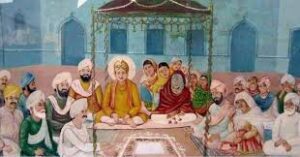
The union of Guru Nanak Dev Ji and Mata Sulakhni in 1487 is a prime example of the Sikh ideal of striking a balance between spiritual devotion and the life of a householder. Guru Nanak’s father, Mehta Kalu, arranged the marriage with the assistance of his son-in-law, Jai Ram, who was employed in Sultanpur Lodhi. Numerous noteworthy incidents during the wedding demonstrated Guru Nanak’s developing spiritual awareness and his early defiance of conventional wisdom.
Arrangement and setting
Guru Nanak was born into a Hindu Khatri family and showed little interest in worldly matters at an early age. His father arranged for him to marry Sulakhni, the daughter of Mool Chand Chona, a well-respected revenue official in the ਪਿੰਡ of Pakkhoke Randhawa, in order to firmly establish him in domestic life. The wedding was held in the Indian town of Batala, which is located in modern-day ਪੰਜਾਬ. Mool Chand was shocked to learn in the days preceding the event that Guru Nanak had defied the customs imposed by Brahmin priests.
Guru Nanak was born into a Hindu Khatri family and showed little interest in worldly matters at an early age. His father arranged for him to marry Sulakhni, the daughter of Mool Chand Chona, a well-respected revenue official in the ਪਿੰਡ of Pakkhoke Randhawa, in order to firmly establish him in domestic life. The wedding was held in the Indian town of Batala, which is located in modern-day ਪੰਜਾਬ. Mool Chand was shocked to learn in the days preceding the event that Guru Nanak had defied the customs imposed by Brahmin priests.
A challenge to orthodoxy
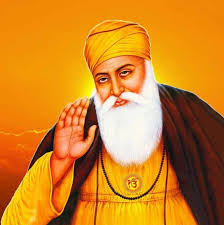
Guru Nanak’s disobedience of custom caused a dispute with the traditional clergy during the pre-wedding talks. Guru Nanak countered that superstitions like matching horoscopes were unnecessary and that a really auspicious moment for a wedding was anytime two souls were ready for union when Mool Chand insisted on a ceremony in accordance with Hindu scriptures. He aimed to substitute a more straightforward, spiritual observance for the ornate, pointless ceremonies.
Guru Nanak’s disobedience of custom caused a dispute with the traditional clergy during the pre-wedding talks. Guru Nanak countered that superstitions like matching horoscopes were unnecessary and that a really auspicious moment for a wedding was anytime two souls were ready for union when Mool Chand insisted on a ceremony in accordance with Hindu scriptures. He aimed to substitute a more straightforward, spiritual observance for the ornate, pointless ceremonies.
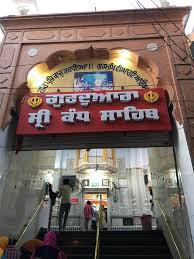
The Gurdwara Kandh Sahib in Batala is a well-known place to remember this argument. According to legend, Guru Nanak sat next to a weathered mud wall and talked with the priests about the wedding. An old woman cautioned him to move because she thought the wall might collapse. According to legend, Guru Nanak grinned and declared that the wall will only fall in accordance with God’s desire, not for centuries. Within the gurdwara, a portion of this wall is still intact and protected by glass.
A sacred and simple ceremony
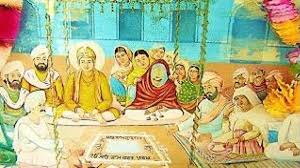
Some reports state that a condensed version of the customary rituals was used for Guru Nanak’s marriage. Guru Nanak and Mata Sulakhni took four circles around a sacred fire, as opposed to the seven rounds that the Hindu tradition called for. According to some documents, the Mool Mantra, a key text in Sikhism, may have served as the basis for these discussions in order to emphasise the spiritual aspect of the union. This was a daring break from the prevailing traditions of the era, prioritising the spiritual commitments over strict social norms.
Some reports state that a condensed version of the customary rituals was used for Guru Nanak’s marriage. Guru Nanak and Mata Sulakhni took four circles around a sacred fire, as opposed to the seven rounds that the Hindu tradition called for. According to some documents, the Mool Mantra, a key text in Sikhism, may have served as the basis for these discussions in order to emphasise the spiritual aspect of the union. This was a daring break from the prevailing traditions of the era, prioritising the spiritual commitments over strict social norms.
Life as a householder
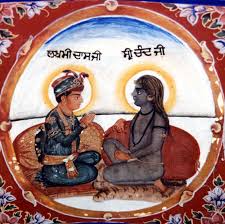
After the wedding, Mata Sulakhni stayed in Talwandi while Guru Nanak settled into a new life in Sultanpur Lodhi, where he worked as a storekeeper. She later joined him there, and the couple had two sons: Sri Chand (born in 1494) and Lakhmi Das (born in 1497). While Guru Nanak’s spiritual journeys took him across vast lands for many years, Mata Sulakhni remained at home, raising their children and managing the household. Her role was critical, providing a stable domestic foundation that enabled Guru Nanak to pursue his divine mission.
After the wedding, Mata Sulakhni stayed in Talwandi while Guru Nanak settled into a new life in Sultanpur Lodhi, where he worked as a storekeeper. She later joined him there, and the couple had two sons: Sri Chand (born in 1494) and Lakhmi Das (born in 1497). While Guru Nanak’s spiritual journeys took him across vast lands for many years, Mata Sulakhni remained at home, raising their children and managing the household. Her role was critical, providing a stable domestic foundation that enabled Guru Nanak to pursue his divine mission.
Mata Sulakhni fully supported her husband’s spiritual path and demonstrated the Sikh ideal of a righteous householder. Her life showed that spiritual devotion was not limited to renouncing the world but could be nurtured within the family unit through love, humility, and selfless service (seva). She served as an anchor for the family and provided hospitality to many of Guru Nanak’s followers, helping to plant the seeds of community and the Langar tradition.
HISTORY Legacy
Guru Nanak and Mata Sulakhni’s marriage laid the groundwork for the Sikhs’ emphasis on grihastha—a harmonious, moral family life—as a means of achieving spiritual enlightenment. Guru Nanak demonstrated to his followers that it was possible to serve God and lead a pious life while yet being completely involved in the world by refusing to leave his wife and kids behind for an austere living. Mata Sulakhni lived out her last years at Kartarpur, adhering to the Sikh customs and principles she had helped create, following the passing of Guru Nanak.
Guru Nanak and Mata Sulakhni’s marriage laid the groundwork for the Sikhs’ emphasis on grihastha—a harmonious, moral family life—as a means of achieving spiritual enlightenment. Guru Nanak demonstrated to his followers that it was possible to serve God and lead a pious life while yet being completely involved in the world by refusing to leave his wife and kids behind for an austere living. Mata Sulakhni lived out her last years at Kartarpur, adhering to the Sikh customs and principles she had helped create, following the passing of Guru Nanak.