After 30 days in detention, the government plans to pursue laws to remove arrested ministers, prime ministers, and chief ministers.
In order to establish a legal mechanism for the automatic removal of important public office holders, such as the Prime Minister, Union Ministers, Chief Ministers, and State or Union Territory Ministers, if they are arrested and held for 30 days in a row on serious criminal charges, the central government is scheduled to introduce three bills in Parliament on Wednesday.
These three bills are
The 2025 Bill to Amend the Government of Union Territories
The Bill for the Constitution’s Thirtieth Amendment, 2025
The 2025 Bill to Reorganise Jammu and Kashmir (Amendment)
What is the most important clause in these bills?
The aforementioned office-bearers shall immediately forfeit their post on the 31st day if they are arrested and held for 30 days in a row for offences carrying a minimum jail sentence of five years.
“A minister who, for any period of 30 consecutive days during holding the office as such, is arrested and detained in custody on allegation of committing an offence under any law for the time being in force, which is punishable with imprisonment for a term which may extend to five years or more, shall be removed from his office by the President on the advice of the Prime Minister to be tendered by the thirty-first day after being taken in such custody,” according to a bill.
It further stated, “Provided that if the advice of the prime minister for the removal of such minister is not tendered to the president by the thirty-first day, he shall cease to be a minister, with effect from the day falling thereafter.”
“Provided further that in case of the prime minister, who for any period of 30 consecutive days during holding the office as such is arrested and detained in custody on allegation of committing an offence under any law for the time being in force, which is punishable with imprisonment for a term which may extend to five years or more, shall tender his resignation by the thirty-first day after such arrest and detention, and if he does not tender his resignation, he shall cease to be the prime minister with effect from the day falling thereafter,” it continued.
Why are these required?
At the moment, neither the constitution nor the law requires that a minister or prime minister be removed from office if they are incarcerated, even for grave crimes. The bills aim to bridge this moral and legal divide.
1. The 2025 Constitution (Thirtieth Amendment) Bill
This bill suggests modifications to:
Article 75 (PM and other Union Ministers)
State ministers, including chief ministers, are covered by Article 164.
Article 239AA (Government of the National Capital Territory of Delhi)
The goal is to prevent detained public officials who are facing serious charges from maintaining their positions of authority.
2. The 2025 Bill to Amend the Government of Union Territories
The Government of Union Territories Act, 1963, Section 45, which presently has no provisions for the removal of ministers or chief ministers of UTs under criminal imprisonment, is intended to be amended.
3. The 2025 Bill to Reorganise Jammu and Kashmir (Amendment)
In order to allow the dismissal of chief ministers or ministers who have been arrested in the Union Territory of Jammu and Kashmir, this bill aims to alter Section 54 of the Jammu and Kashmir Reorganisation Act, 2019, for similar reasons.
What caused this action?
High-profile instances where ministers or other officials refused to step down while incarcerated seem to have sparked the action. Notably, V. Senthil Balaji, the minister of Tamil Nadu, and former Delhi Chief Minister Arvind Kejriwal. Both remained in their positions in spite of being detained in different incidents, which raised concerns about ethics and accountability in government.
Next up?
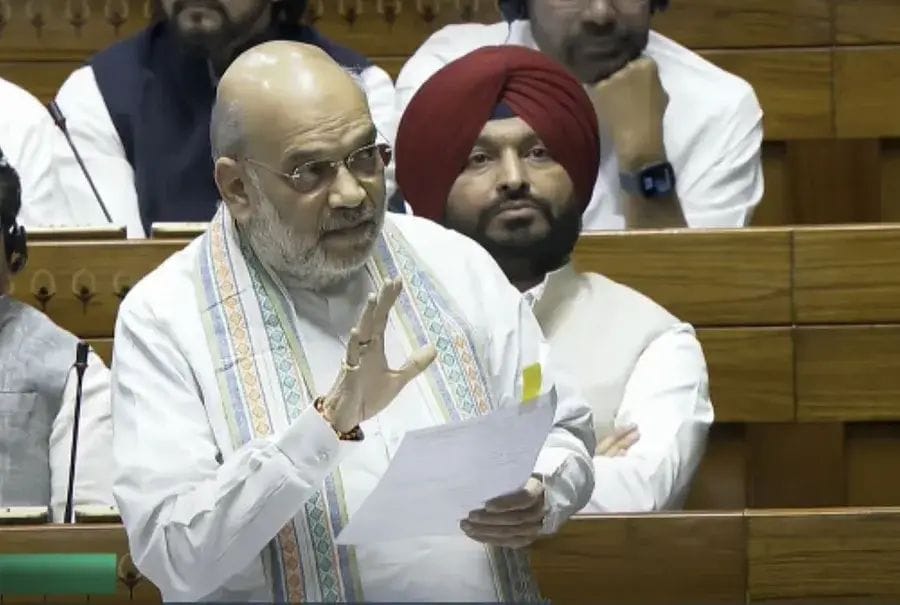
In order to send the three proposals to a Joint Committee of Parliament for additional review and recommendations, Union Home Minister Amit Shah is anticipated to introduce a resolution in the Lok Sabha.