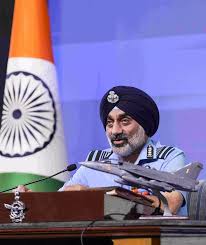
Big Operation Sindoor Revelation: Indian Armed Force Took Down Five Pakistani Jets During Operation Sindoor, Says Air Force ਮੁੱਖ.
In a daring announcement on Thursday, Indian Air Force (IAF) ਮੁੱਖ Air Marshal Amar Preet Singh said that the IAF has successfully shot down one AWACS aircraft and five enemy fighter jets during Operation Sindoor.
Singh highlighted the IAF’s strategic skills in contemporary warfare by calling the operation a “decisive move” carried out with accuracy and a clear goal during a ਖ਼ਬਰਾਂ briefing in New Delhi.
Pakistan Experienced Serious Damage
Singh stated that the Indian Air Force has caused “substantial damage” to several important military assets in response to a question from the media regarding Pakistan’s losses during Operation Sindoor.
“We struck a large number of their airfields and installations,” he stated. Two command-and-control centres and at least four radars were destroyed. Three hangars at various stations were struck, while runways at two bases sustained damage. We also have proof that at least four or five fighter aircraft, most likely F-16s that were undergoing maintenance at the time, as well as one C-130 class aircraft, were damaged.
He also disclosed that one Surface-to-Air Missile (SAM) system was destroyed, along with a long-range attack that travelled more than 300 km and struck what was thought to be either a Signals Intelligence (SIGINT) platform or an Airborne Early Warning & Control (AEW&C) aircraft. “Alongside that, our systems confirm the destruction of five high-tech fighters between the F-16 and JF-17 classes,” Singh continued.
Rejecting Pakistani Claims The IAF ਮੁੱਖ flatly denied Pakistan’s claim that it had shot down 15 Indian fighter jets when questioned about it. “If Pakistan believes they have shot down 15 Indian jets, let them think,” Singh said. “Unka jo narrative hai, manohar kahaniyaan hai, chalney do (Their narrative is like a fairy tale – let it continue).” His comments exposed the propaganda-driven narratives from the other side of the border and demonstrated ਭਾਰਤ’s confidence in its operational record.
S-400 Air Defence System Proven Effective
Air ਮੁੱਖ Marshal Singh praised the S-400 missile defence system, which was deployed during the operation. “The S-400 has proved to be a good weapon system,” he said, highlighting its effectiveness in neutralising enemy aircraft and strengthening ਭਾਰਤ’s layered defence network.
‘Sudarshan Chakra’, ਭਾਰਤ’s Iron Dome, is under construction.
Singh revealed in a significant statement that construction has already started on ਭਾਰਤ’s domestic air defence system, known as Sudarshan Chakra, which is being compared to the Iron Dome.
“We have put our heads together and begun work on Sudarshan Chakra,” he stated. “The necessity for Atmanirbharta is critical. For vital systems, we cannot continue to rely on others.
He went on to say that the domestic project would significantly improve ਭਾਰਤ’s capacity to intercept enemy missiles and planes, providing a protective barrier against potential aerial threats.
Warfare Ready for the Future
The IAF ਮੁੱਖ emphasised that the nature of combat is changing quickly in the future. “The next battle won’t be like the last one. “We need to be prepared for the future,” he remarked.
Singh underlined that Operation Sindoor has shown how important air power is in influencing battlefield results. “After this operation, air power has gained prominence. The conflicts of tomorrow will continue to be characterised by precision strikes, long-range weaponry, satellite reconnaissance, and strong air defence systems.
Additionally, he claimed that ਭਾਰਤ had a clear goal when it entered the most recent fight and that it quickly concluded after its objectives were met. He emphasised that the world, where many ongoing conflicts show no indications of ending, should learn from this strategy.
Singh continued, “We proved that we are ‘Achook (infallible), Abhedya (impenetrable) and Sateek (accurate)’ during Op Sindoor; all three services planned and executed this mission.”
“The Indian Armed Forces were given a clear mandate and directive. “This war will be remembered as one that started with a clear goal and ended quickly, without needless delay,” Singh stated.
“We are witnessing wars around the world where there is no discussion on termination,” he continued, drawing a comparison to international conflicts. However, we
successfully persuaded our enemy to seek a ceasefire and put an end to the fighting. As a country, we made the decision to end operations when our goals were achieved. We have something to teach the world about this.