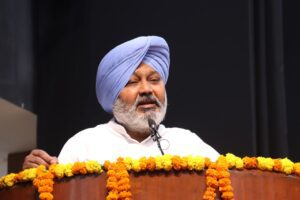
Under the “Yudh Against Drugs” campaign, Health Minister Dr Balbir Singh introduces advanced training for medical officers in Mohali.
Reaffirms the government’s commitment to making Punjab drug-free under Bhagwant Singh Mann
The State Introduces Liquid and Oral Substitution Therapy for Drug Addicts
August 26, 2025, Sahibzada Ajit Singh Nagar:
The Cluster Resource Centre (Ambedkar Institute of Medical Sciences) in Mohali hosted a capacity-building training session for medical officers today, which was opened by Dr Balbir Singh, Punjab’s Minister of Health and Family Welfare. This programme seeks to offer cutting-edge training for treating drug addicts and is a component of the Punjab government’s “Yudh Against Drugs” campaign.
“This training program is part of a larger strategy to strengthen Punjab’s de-addiction and rehabilitation services through the Data Intelligence and Technical Support Unit established at AIIMS, Mohali, in collaboration with the Ananya Birla Foundation,” he stated. He went on to say that the unit serves as a hub-and-spoke model to guarantee smooth technical support and on-the-ground implementation throughout the state, with the help of prestigious national institutions like the Tata Institute of Social Sciences Mumbai, PGI Chandigarh, IIT Ropar, and the National Drug Dependence Treatment Centre (All India Institute of Medical Sciences).
Dr Balbir Singh went on to say, “The Punjab government’s top priority is the war against drugs. We are committed to increasing the accessibility and patient-centredness of treatment services through scientific training, real-time monitoring, and the development of de-addiction infrastructure. Psychologists, police officers, counsellors, and medical officers are receiving increased training and abilities to deliver professional, sensitive, and efficient care.
A five-day training programme including theoretical knowledge, practical skills, and legal awareness is being conducted by psychiatrists educated by AIIMS at the Ambedkar Institute of Medical Sciences, Mohali, as part of this initiative, he said. Enhancing medical officers’ and support staff’s ability to effectively manage substance use disorders at the local level is the aim.
The health minister described Punjab’s extensive de-addiction network, stating that over 5,000 beds had been made available for de-addiction and rehabilitation throughout the province. At 36 government de-addiction centres, 19 government rehabilitation centres, 143 private de-addiction centres, and 72 private rehabilitation centres, the government is offering free treatment, which includes boarding, housing, food, and medication.
In a similar vein, Punjab is becoming drug-free thanks to 547 OOAT (Outpatient Opioid Assisted Treatment) clinics and their 10.31 lakh enrolled patients.
Dr Balbir Singh added that the method is being extended to Jalandhar, Mohali, Faridkot, and Patiala after beginning methadone-based treatment for drug abusers in Amritsar, Bathinda, and Kapurthala. By utilising this technique, addicts will be less likely to use the same needle and suffer related injuries. He said this is part of the state’s adoption of liquid and oral substitution therapy for treating drug addicts.
The state’s emphasis on real-time monitoring via the DDRP (Drug De-addiction and Registry) portal and the participation of Cluster Resource Centres (CRCs) in medical colleges in Mohali, Patiala, Amritsar, Jalandhar, and Faridkot to carry out state-level strategies locally were also highlighted by the health minister.
The commitment of the medical officers and specialists was commended by Dr Balbir Singh, who said that their combined efforts would guarantee “a healthy and drug-free Punjab”.
Basant Garg, Punjab’s Secretary of Health and Family Welfare; Bhavneet Bharti, Director Principal of Ambedkar Institute of Medical Sciences, Mohali; Navdeep Saini, Medical Superintendent (AIMS); Dr Sangeeta Jain, a civil surgeon; and a group of 35 medical officers were among the officials in attendance. Four psychiatrists with training from AIIMS served as master trainers for the medical officers.