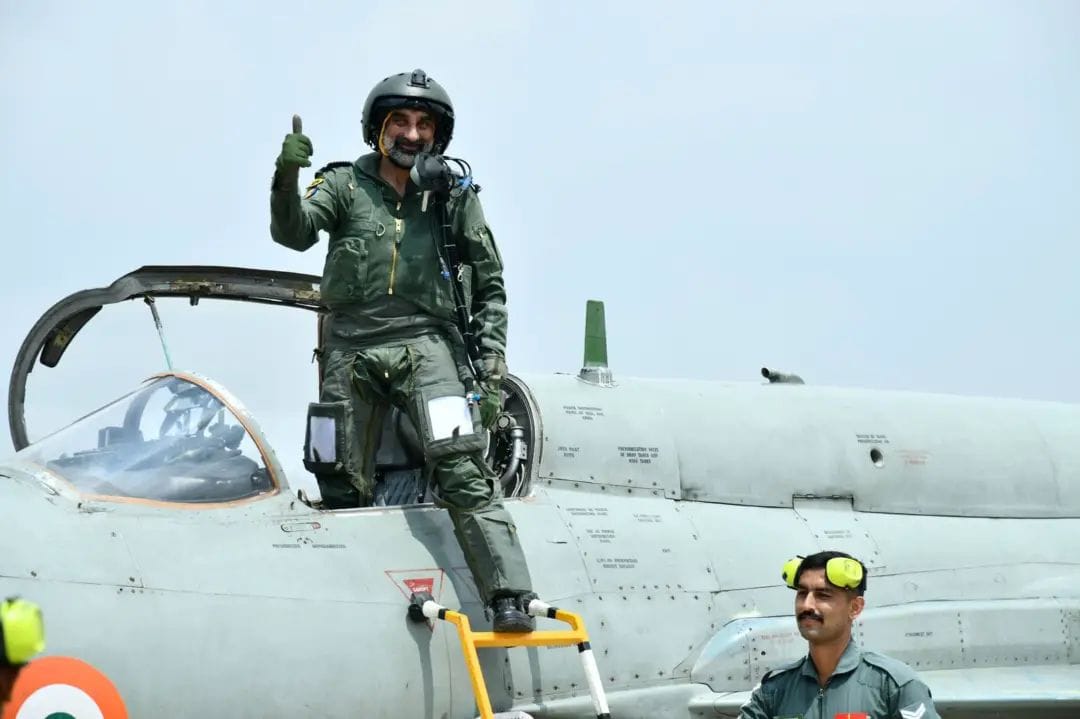
IAF ਮੁੱਖ flies MiG-21 amid final farewell.
The legacy of 6 decades ends on Sept 26.
With a month to go before the formal retirement of the last few MiG-21 fighter jets, Indian Air Force (IAF) ਮੁੱਖ Marshal AP Singh flew a sortie in the jet from the air base at Nal, Bikaner, Rajasthan, ਅੱਜ.
Accompanying him was Squadron Leader Priya Sharma, IAF said.
On September 26, the final two MiG-21 squadrons will retire, capping a six-decade legacy. This final celebration will take place at the Chandigarh air station, where the MiG-21s arrived in April 1963 and joined the IAF squadron known as ‘The First Supersonics’. After being delivered to Mumbai dismantled, the aircraft were put together by a group of Soviet engineers and tested by their pilots. Six hundred and fifty of these jets were licensed to Hindustan Aeronautics Limited (HAL). Radars, missiles, and avionics were all updated with newer models over time.
The aircraft, including every version flown by the IAF, have participated in several missions over the last 62 years, including the Kargil battle in 1999, the 1971 Bangladesh war, and the most recent air duel following the Balakote airstrike. Abhinandan Varthaman, the group captain, was piloting a MiG-21. Over 170 pilots were killed in over 490 MiG-21 mishaps or crashes overall. By 1994, the IAF hoped to have a MiG-21 successor ready. In 1985, the final version of the MiG-21 Bis was manufactured.
Prior to the introduction of the MiG-21 Bis variant into the IAF, the MiG-21 was a point defence fighter. However, it was designed for air-to-air combat, specifically within the pilot’s visual range with short-range air-to-air missiles. The Mikoyan-Gurevich Design Bureau of the former Soviet Union created the MiG-21, which made its first flight in 1955.
Also, with the last two MiG-21 squadrons and the phase-out of these two, the number of fighter jet squadrons will plunge to 29, the lowest in six decades. As per a decision of the Cabinet Committee on Security (CCS), IAF needs 42 squadrons of jets for a two-front collusive war with Pakistan. Each squadron has 16 to 18 jets.
The induction of the Tejas Mark-1A fighter jet, aimed at bolstering the numbers, has been delayed. Deliveries of the jet were to start in March 2024, with at least 16 planes to be delivered to the IAF every year. So far, not a single Tejas Mark-1A has been delivered by the manufacturer, HAL.