A record for the deepest marine descent was set by two Indian aquanauts about a month after Shubhanshu Shukla arrived at the International Space Station. Indian aquanauts used the French submarine ‘Nautile’ to successfully perform a deep dive in the North Atlantic Ocean on August 5 and 6 as part of a cooperative operation with France. Raju Ramesh, a scientist at the National Institute of Ocean Technology, made a 4,025-metre descent on August 5 near Horta, Portugal. The retired Indian Navy Commander Jatinder Pal Singh dove to a depth of 5,002 metres on August 6.
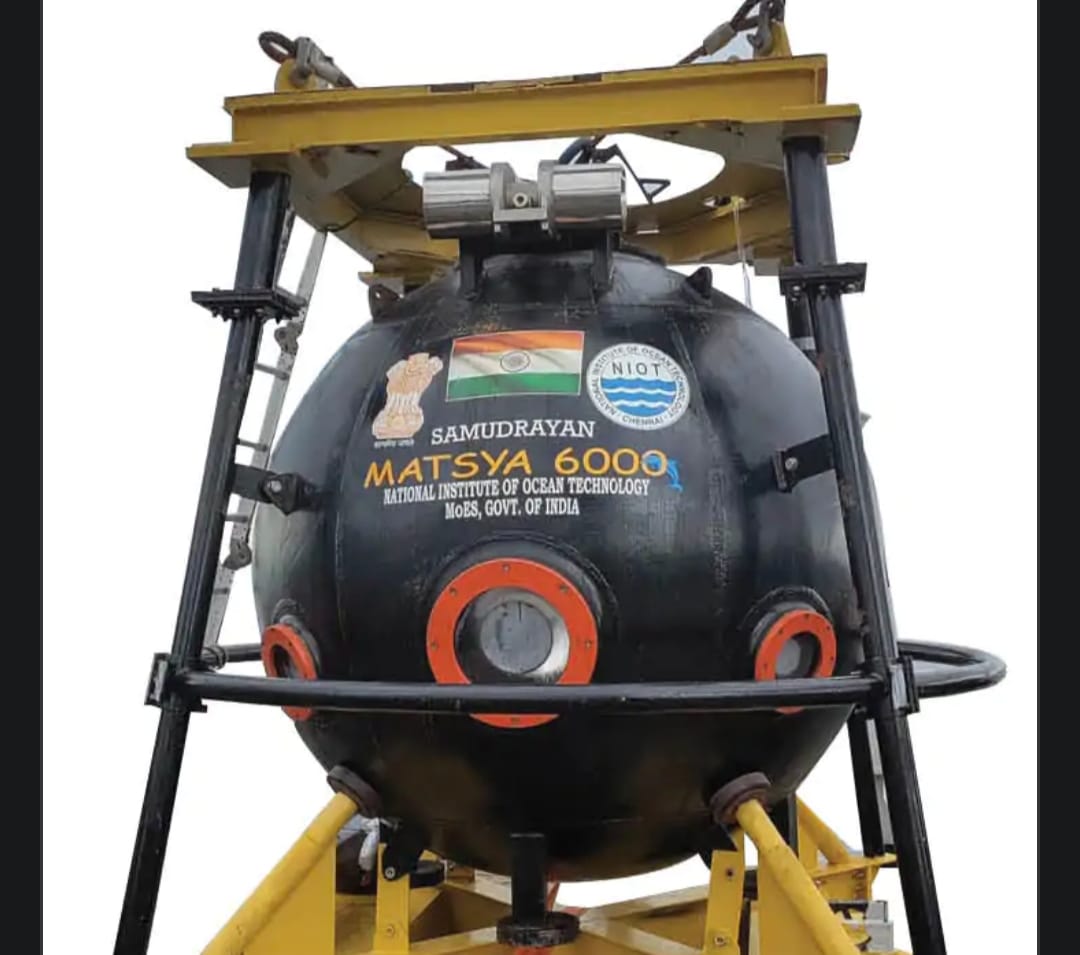
A component of the preparations for ਭਾਰਤ’s Samudrayan ‘Matsya 6000’ is this expedition. The ‘Matsya 6000’ submarine built in ਭਾਰਤ is scheduled for launch in 2027. Within the sea, it will descend to a depth of 6,000 metres. ਭਾਰਤ has constructed a human-occupied submersible, making it the sixth nation to do so. The US, Russia, Japan, France, and China have previously constructed manned submersibles.

Matsya 6000′ is built from titanium alloy.
The ‘Matsya 6000’ submersible can run for 12 to 16 hours straight. For up to ninety-six hours, it will be supplied with oxygen. It can accommodate three ਲੋਕ and has a diameter of 2.1 metres. It is composed of a titanium alloy measuring 80 mm. At a depth of 6000 metres, it can tolerate pressure up to 600 times more than the sea surface pressure, or 600 bar (a unit of measurement for pressure).
What is a submersible, and how is it different from a submarine?
Submarine: Consider it a separate underwater vessel. It is big, can accommodate a lot of ਲੋਕ, and can go far on its own—both on land and underwater. The military mostly uses them for patrolling and espionage. Consider the term “submersible” to describe a tiny, specialised underwater vehicle. It requires a larger ship to transport it to the destination and then launch it into the water because it is not self-sufficient. Submersibles are typically smaller, can only accommodate a small number of passengers, and are employed for specialised missions—most frequently for scientific investigation and study rather than military objectives.
The effort to extract metals from the seabed.
The demand for e-vehicles and their batteries is actually rising quickly in an effort to combat global warming. The materials needed to produce them are also getting harder to get globally. Batteries use lithium, copper, and nickel that are found at the ocean’s depths. At the same time, manganese, which is vital to the steel sector, and cobalt, which is required for electric vehicles, are also found in the ocean’s depths. The world is expected to require 70% more cobalt and twice as much lithium in three years. Meanwhile, according to the International Energy Agency, the requirement for cobalt would increase fourfold and lithium by approximately fivefold by 2030. These raw resources are produced at a far lower rate than they are needed. One potential solution to close this disparity is deep-sea mining.