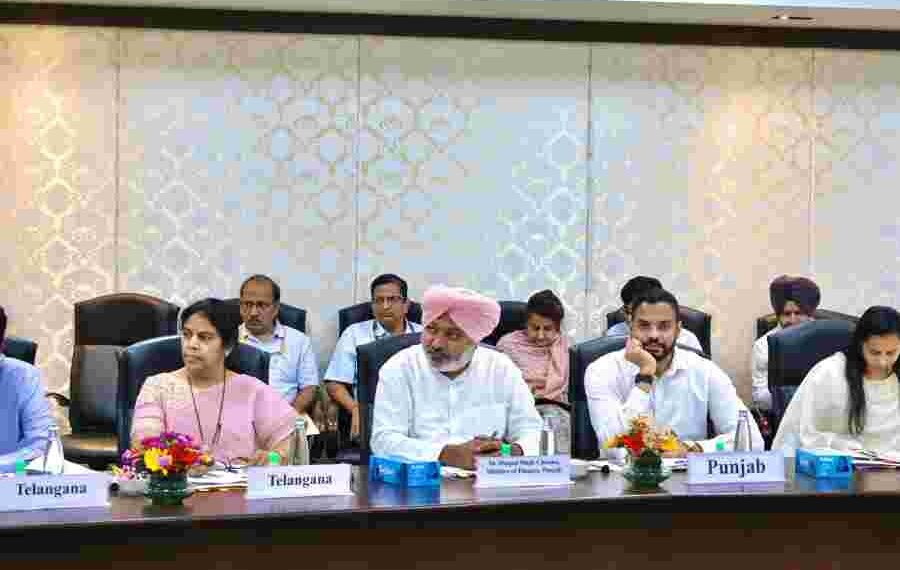
Punjab Finance Minister Harpal Singh Cheema on Friday highlighted the urgent need for structural changes in the Goods and Services Tax (GST) system, pointing out that the state has faced a massive revenue shortfall of Rs 47,037 crore in the past three years due to the subsuming of several key taxes under GST.
Speaking at a meeting of the Group of Ministers (GOM) reviewing GST revenue, Cheema stressed the importance of including foodgrains under the GST framework to help offset the ongoing revenue deficit, especially considering Punjab’s landlocked and agriculture-based economy. He also recommended establishing a unified platform that would allow states and the central tax authorities to better detect tax evasion and improve compliance.
Cheema detailed how Punjab’s reliance on taxes such as the purchase tax and infrastructure development fee on grain sales (wheat and rice) suffered due to their subsumption under GST. These taxes contributed significantly to the state’s revenue—Rs 3,094 crore in 2015-16, accounting for about 16.55% of Punjab’s total tax income. The abolition of these taxes led to a permanent revenue loss.
He further pointed out losses from the removal of the Central Sales Tax (CST), which had brought in Rs 568 crore in 2015-16. Comparing the current GST system with the earlier Value Added Tax (VAT) regime, Cheema said Punjab’s revenue collections were consistently higher under VAT.
Since GST’s implementation in July 2017, Punjab’s actual tax revenue has lagged behind projections based on expected growth rates. Cheema noted that even with a conservative 10% compound annual growth rate (CAGR), the state would have been in a better financial position without GST.
The Finance Minister urged that states heavily dependent on agriculture, like Punjab, receive compensation for the permanent revenue loss due to the subsuming of purchase tax on foodgrains.
He also raised concerns about a paradox in major industrial sectors in Punjab—such as agricultural implements, cycles, cycle parts, and hosiery goods—that show high gross turnovers but do not correspond with similar GST revenue growth. This, he explained, is due to GST’s nature as a destination-based consumption tax, resulting in revenue flowing out of Punjab through input tax credit adjustments.
Additionally, Cheema called for policy changes to address the inverted duty structure in GST, which causes significant refunds and reduces cash collections for the state. He said Punjab disburses roughly Rs 1,200 crore annually in refundsbecause of this structure and exports, further straining the state’s finances.
The minister’s call for reforms highlights the ongoing challenges faced by Punjab under the current GST framework and the need for policy interventions to ensure fairer revenue distribution.