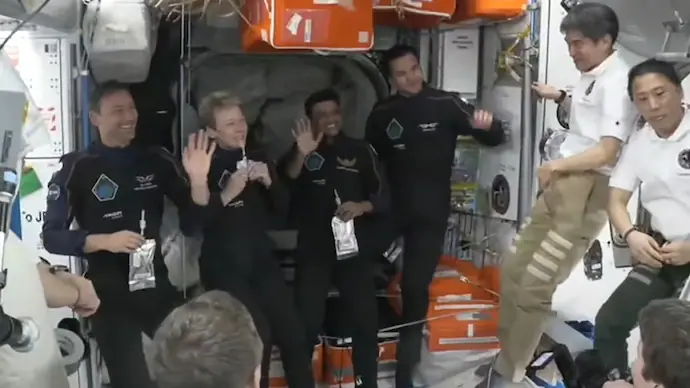
After docking successfully with the International Space Station (ISS) on Thursday at 4:15 pm, the four-member Axiom-4 mission crew spent their first day aboard the orbiting laboratory settling in, completing handover tasks, and preparing for a packed schedule of science and outreach.
In a statement, Axiom Space said the astronauts are “happy, healthy, and eager to begin a full slate of microgravity research, technology demonstrations, and outreach engagements.”
Sleeping Quarters Assigned Across Modules
Each crewmember has been assigned a different sleeping module:
-
Commander Peggy Whitson is staying in the Quest Airlock
-
Pilot Shubhankar Shukla is housed in Dragon spacecraft Grace
-
Mission Specialist Sławosz Uznanski-Wisniewski in the Columbus module
-
Tibor Kapu in the Japanese Experiment Module (JEM)
The fifth “member” of the team — Joy, a swan-shaped plush toy used as the zero-gravity indicator — made its microgravity debut during an in-flight event shortly before docking.
Research-Focused Mission Ahead
Over the next 14 days, the Ax-4 crew is set to carry out around 60 scientific investigations and activities representing 31 countries, making this the most research-intensive mission Axiom has ever conducted aboard the ISS.
The team has already completed several critical operational tasks, including cargo unpacking and emergency protocol reviews.
More Than Just Science
In addition to research, the crew will also participate in media events, educational initiatives, and outreach activities designed to inspire the public and share their experience of life and work in space.
Before diving into their full workload, the astronauts will continue spending time acclimating to the space environment and finalizing setup as the newest temporary residents of the ISS.
Axiom-4 highlights the growing role of commercial spaceflight in international science and cooperation, and further strengthens efforts to expand human presence and research capabilities in low-Earth orbit.