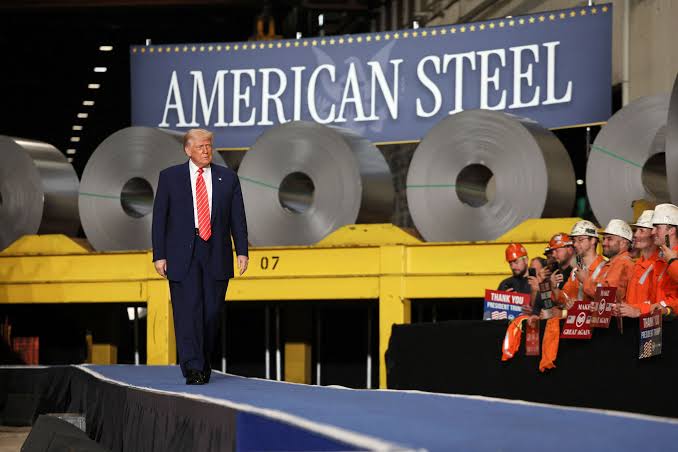
US President Donald Trump announced on Friday that tariffs on imported steel and aluminium will be doubled from 25% to 50%, escalating his trade war and drawing criticism from global allies and trade partners.
Speaking at a rally near Pittsburgh, Pennsylvania, Trump said the move aims to further protect the US steel industry. “We’re going to bring it from 25% to 50% — the tariffs on steel into the United States of America — which will even further secure the steel industry in the United States,” he declared.
The announcement came as Trump praised a USD 14.9 billion acquisition deal between Nippon Steel and US Steel, calling it a win for American jobs. He later confirmed on social media that the increased tariffs will also apply to aluminium and take effect on Wednesday.
The announcement had immediate market impact — shares of steelmaker Cleveland-Cliffs Inc surged 26% after hours, as investors anticipated higher profits due to the new trade barriers.
The decision drew sharp backlash from key US allies. Canada’s Chamber of Commerce called the move “antithetical to North American economic security,” warning of disruptions to cross-border supply chains. Australia’s Trade ਮੰਤਰੀ Don Farrell called the tariffs “unjustified” and “an act of economic self-harm,” vowing to push for their removal.
The increased tariffs also follow Trump’s accusation that China breached a trade agreement on critical minerals, further straining US-China relations.
The US remains the largest steel importer globally, excluding the European Union, with 26.2 million tons of steel imported in 2024. Analysts warn the new tariffs could drive up prices across industries, affecting both manufacturers and consumers.
The move was enacted under Section 232 national security provisions and covers a broad range of metal-based products, from raw materials to items like aluminium pans, steel door hinges, and air conditioner parts.
In 2024, the US imported USD 147.3 billion worth of steel and aluminium goods across 289 product categories. The latest tariff hike is nearly three times larger in scope than Trump’s 2018 tariffs on Chinese industrial goods, signaling a renewed aggressive trade stance ahead of the elections.